
Adrenal Fatigue vs. Burnout: What’s Really Happening in Your Body?
Adrenal Fatigue vs. Burnout: What’s Really Happening in Your Body?
By Kimber Williamson, MSN RN | Kimber Williamson Wellness, LLC
Introduction
You’re exhausted, wired-but-tired, and running on empty. But is it adrenal fatigue or burnout? They can look almost identical on the surface, but they have different root causes and different paths to healing — and knowing where you are in these cycles matters more than most people realize.
First, let’s reframe the term “adrenal fatigue.” The more accurate name is HPA axis dysfunction — referring to the Hypothalamic-Pituitary-Adrenal axis, your brain’s command center for stress response. When chronic stress disrupts this system, the result is an alteration in how your body responds to demands. This can stem from PTSD, chronic inflammation, nutrient deficiencies, hormone changes, and more.
Burnout is primarily driven by emotional and psychological input — a blunted response seen in caregivers, stay-at-home mothers, high-achieving professionals, and anyone who has been running on fumes for too long. Both can fuel each other. Burnout can drive HPA axis dysfunction over time, and HPA axis dysfunction makes burnout feel insurmountable. When they’re feeding each other, a vacation or a self-care Sunday isn’t going to fix it. The body’s regulatory system has been altered — not just your mindset.
This isn’t just a cortisol issue. It is a lifestyle, nervous system, brain, diet, and whole-body issue. In this blog, we’ll walk through what HPA axis dysfunction and burnout actually looks like — physiologically and cyclically — and what you can do about it.
The Adrenal Glands & the HPA Axis
It is amazing what these little glands can do. Sitting on top of each kidney, the adrenal glands are made up of two regions: the cortex (outer layer) and the medulla (inner layer). The cortex produces steroid hormones — cortisol, aldosterone, DHEA, and androgens. The medulla produces epinephrine and norepinephrine, the hormones driving your immediate fight-or-flight response.
Worth noting: the adrenals don’t directly produce significant estrogen, but they do produce androgen precursors like DHEA and androstenedione, which are converted to estrogen in peripheral tissues. This becomes especially important in perimenopause and menopause when ovarian hormone production declines and the adrenals become a primary backup system.
Cortisol Is Not the Bad Guy
The HPA axis — hypothalamus, pituitary, and adrenal glands — is your brain’s command center for stress. Cortisol is not the villain here. It is a necessary, life-sustaining hormone that follows a natural daily rhythm — peaking 30–45 minutes after waking, then gradually declining throughout the day. It modulates inflammation, raises blood sugar through gluconeogenesis, supports blood pressure, and regulates cognitive function. In a healthy rhythm, cortisol is anti-inflammatory. The problem is not cortisol itself — it is chronic dysregulation of its natural rhythm.
How the System Breaks Down
In acute stress, the hypothalamus releases CRH, which signals the pituitary to release ACTH, which signals the adrenals to produce cortisol. As cortisol rises, it feeds back to the brain to reduce CRH and ACTH — a built-in self-regulation loop.
In chronic stress, this feedback loop breaks down. The receptors at the hypothalamus and pituitary become desensitized — they can no longer “hear” cortisol’s signal. CRH and ACTH keep driving cortisol production even when the stressor is gone. Over time the system becomes less capable of responding at all. The end result is a blunted, flattened cortisol curve — and that shows up as morning exhaustion, afternoon crashes, wired-at-night, salt cravings, low libido, poor stress tolerance, and blood sugar dysregulation.
“Adrenal fatigue” is not a recognized conventional diagnosis. Because symptoms are so nonspecific, getting answers through standard care can feel like hitting a wall. That’s exactly why looking at the full cortisol pattern throughout the day — not just a single snapshot — is what matters. The fluctuations tell the story.
What Is Burnout?
The World Health Organization defines burnout specifically as an occupational phenomenon — arising from chronic, unmanaged workplace stress. But research is catching up to what many women already know: the mental, emotional, and physical labor of caregiving, motherhood, and high-achieving life carries the same physiological weight.
Over time, chronic burnout drives real physiological changes. Increased HPA axis signaling then ramps up cortisol and neurotransmitter production, resulting in the entire system in overdrive. Rest provides temporary relief — but as soon as the demands return, the signaling ramps right back up.
Who Is Most at Risk
Healthcare workers, police officers, caregivers, and high-performing professionals carry a disproportionate burden. Women managing simultaneous mental, emotional, and physical loads are especially vulnerable. Type A personalities — ambitious, competitive, with poor boundary control — have a harder time stepping off the accelerator. Research also shows that people raised in hostile or emotionally disapproving environments carry an elevated baseline risk, as their nervous systems were conditioned early to stay on high alert.
Burnout in stay-at-home mothers is an increasingly recognized area of research. The constant mental load of scheduling, meal prepping, managing emotions, running kids to appointments, and maintaining a marriage keeps the nervous system in near-constant stimulation with very little opportunity for true recovery. Researchers define parental burnout as emotional exhaustion, overwhelm, and reduced capacity — and the data backs it up.
This shows up as fatigue, sleep disturbances, irritability, anxiety, and feelings of isolation or hopelessness. It is often internalized as failure. It is not. It is a body under sustained demand without adequate recovery or support. That is not a character flaw. That is a body asking for help.
When Burnout and HPA Dysfunction Collide
When burnout becomes chronic and the HPA axis is constantly stimulated, the system begins to break down. Cortisol rises, signaling intensifies, receptors become desensitized — and eventually cortisol drops. What started as too much becomes too little. This is how you end up with both burnout and HPA axis dysfunction running simultaneously, each feeding and amplifying the other in a cycle that is very difficult to break on willpower alone.
This is also where conventional medicine tends to fall short. Standard lab work doesn’t flag HPA axis dysfunction until physiological changes are already well underway. A single cortisol blood draw tells you almost nothing about what the pattern looks like across the day.
Functional medicine takes a different approach. When we slow down, listen to the whole person, look at symptoms in context, and use functional lab work to assess the pattern — we can often catch dysregulation before it becomes full dysfunction. And when dysfunction is already present, we work backwards to find the root cause — not just manage symptoms.
What’s Happening in Your Body
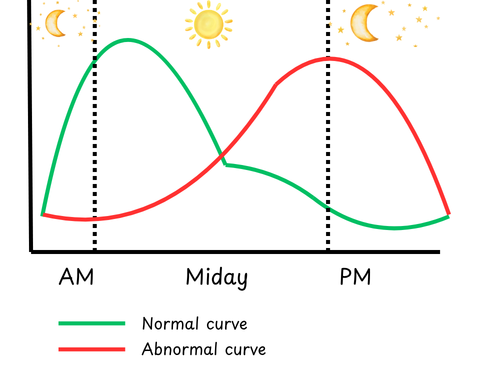
Cortisol follows a natural 24-hour curve. It begins rising before you wake, peaks in the morning, declines through the afternoon, and hits its lowest point at bedtime. When this rhythm is disrupted, you feel it.
High cortisol all day: No gradual decline, stuck in overdrive. Tired-but-wired — exhausted but unable to relax or sleep.
Flat or low cortisol: No morning spike, low all day. Late-stage dysfunction. You wake already exhausted and never recover.
Reverse curve: Low in the morning, spikes in the afternoon or evening. Sluggish all day, racing thoughts at night, can’t fall asleep.
The pattern matters. A single cortisol measurement tells you almost nothing.
The Downstream Effects
Cortisol doesn’t operate in a silo. When it’s chronically dysregulated, it pulls other systems down with it.
Gut: Chronically high cortisol disrupts the microbiome, drives inflammation at the gut lining, and can lead to leaky gut and increased systemic inflammation.
Estrobolome: The estrobolome is the gut bacteria responsible for regulating estrogen metabolism — whether estrogen gets excreted or reabsorbed. An enzyme called beta-glucuronidase controls this process. Too much activity may drive estrogen dominance; too little may leads to estrogen depletion — a particular problem during perimenopause and menopause. High cortisol disrupts the estrobolome through inflammation and dysbiosis.
Thyroid: Chronic stress suppresses thyroid function. Cortisol reduces the conversion of T4 (inactive) into T3 (active), and can increase reverse T3 — a metabolic brake. This is why people under chronic stress develop symptoms that look exactly like low thyroid — fatigue, brain fog, cold intolerance, hair changes, low motivation — even when labs come back “normal.” Low thyroid also increases cortisol demand, creating another feedback loop.
Sex hormones: Cortisol and progesterone share structural similarity and compete at the receptor level. Chronic stress suppresses the hormonal pathway that drives progesterone production. Low progesterone in the setting of chronic stress shows up as irregular cycles, worsening PMS, low libido, anxiety, and poor sleep. The body is intelligently prioritizing survival — and until you address the stress load driving that pattern, hormone support alone will only get you so far.
Once chronic stress pulls the gut, thyroid, and sex hormones into dysfunction, willpower and rest are no longer enough. The physiology is driving the symptoms. This is why where you are in the process matters — the plan looks different depending on how far down the path the dysregulation has gone.
How to Know What You’re Actually Dealing With
Knowing where you are starts with two things: paying attention to your own patterns, and getting the right data.
Start With Your Own Body
Before any lab work, start tracking how you feel throughout the day. A simple journal is one of the most underutilized tools in this process. Note whether you wake exhausted, when your energy crashes, whether you get a second wind late at night, or whether you’re waking at 2 AM unable to fall back asleep. These patterns map directly onto the cortisol curves above.
Functional Lab Testing
DUTCH Test: The gold standard for cortisol patterns. Using multiple dried urine samples throughout the day, the DUTCH shows the full cortisol curve — not just a single snapshot. It also provides data on progesterone, estradiol, testosterone, and how those hormones are being metabolized. This is the test that tells the full hormonal story.
GI MAP: Because cortisol disrupts the microbiome and gut dysfunction feeds cortisol dysregulation right back — assessing the gut is not optional. The GI MAP identifies inflammation, infections, and dysbiosis that may both reflect and perpetuate elevated cortisol.
Comprehensive Thyroid Panel: A full panel — not just TSH — gives a complete picture of T3, T4, reverse T3, and whether autoimmune antibodies are involved. Sluggish thyroid means sluggish everything else, and standard panels routinely miss this.
Why Standard Bloodwork Falls Short
A cortisol level drawn at your PCP’s office shows one moment in time. It tells you nothing about what cortisol is doing across the full day. Standard thyroid panels have the same limitation. They show disease, not dysfunction. By the time something flags on conventional labs, the body has often been compensating for a long time. Functional lab work catches what standard panels miss — and that’s the difference between finding answers and being told everything looks normal when you know it doesn’t.
What Healing Actually Looks Like
Healing starts with investigation, not guessing. The curve — or lack of curve — tells us how to approach recovery. Late-stage HPA axis dysfunction looks completely different from early dysregulation. The plan has to match where you actually are.
Lifestyle Foundations
Sleep and light exposure: Consistent sleep habits and minimizing stimulation at night matter — but so does getting outside in natural light shortly after waking. Morning light is one of the most powerful ways to anchor your cortisol curve to your circadian rhythm.
Blood sugar stability: Cortisol is a counter-regulatory hormone to insulin. When blood sugar drops in the middle of the night, cortisol rises early to stabilize it — which is why some people wake at 2 or 3 AM for no apparent reason. A small, balanced snack before bed may prevent that early spike and keep sleep intact.
Nervous system regulation: The HPA axis responds to perceived stress — not just actual stress. When the nervous system is in a constant state of threat signaling, cortisol stays elevated regardless of what’s happening in your external life. Teaching the body it is safe — through breathwork, vagal tone practices, and removing chronic stressors where possible — is a core part of resetting the system.
Targeted, Individualized Support
Because everyone’s biochemistry, genetics, and stressor load is different, a blanket protocol doesn’t work. What works is a plan built from actual data — your labs, your symptoms, your lifestyle — adjusted over time as your body responds.
This is exactly what Kimber’s VITAL Method is designed to do. We start with functional lab testing guided by your specific symptom picture, build an individualized plan around what your body actually needs, and provide high-touch concierge support throughout — because change requires strategy, reassessment, and adjustment along the way. We address lifestyle, nutrition, and targeted supplementation where indicated, with the goal of getting your body out of survival mode and into a state where it can actually heal.
Your body is not broken. It has been doing exactly what it was designed to do under chronic stress. It just needs the right support to find its way back.
You’ve Been Overlooked Long Enough
If you recognized yourself somewhere in these pages — the wired-but-tired evenings, the morning exhaustion that never lifts, the feeling that something is off but every lab comes back normal — you are not imagining it. And you are not broken.
HPA axis dysfunction and burnout are real, measurable, and reversible. But they require someone willing to look at the whole picture, not just the loudest symptom. The difference between white-knuckling through your days and actually healing comes down to one thing: knowing what is driving the cycle. Not guessing. Actually investigating.
That is what I do.
Start by downloading my free guide — The 5 Systems That Control Your Energy — and learn exactly how these systems connect and what to look for in your own body.
References
Huberman, A. (2025, August 4). How To Control Your Cortisol & Overcome Burnout. How to Control Your Cortisol & Overcome Burnout. May 27, 2026, hubermanlab.com/episode/how-to-control-your-cortisol-overcome-burnout
Khammissa, R. A. G., Nemutandani, S., Feller, G., Lemmer, J., & Feller, L. (2022). Burnout phenomenon: Neurophysiological factors, clinical features, and aspects of management. Journal of International Medical Research, 50(9). https://doi.org/10.1177/03000605221106428
World Health Organization. (2019, May 28). Burn-out an “Occupational phenomenon”: International Classification of Diseases. World Health Organization. https://www.who.int/news/item/28-05-2019-burn-out-an-occupational-phenomenon-international-classification-of-diseases